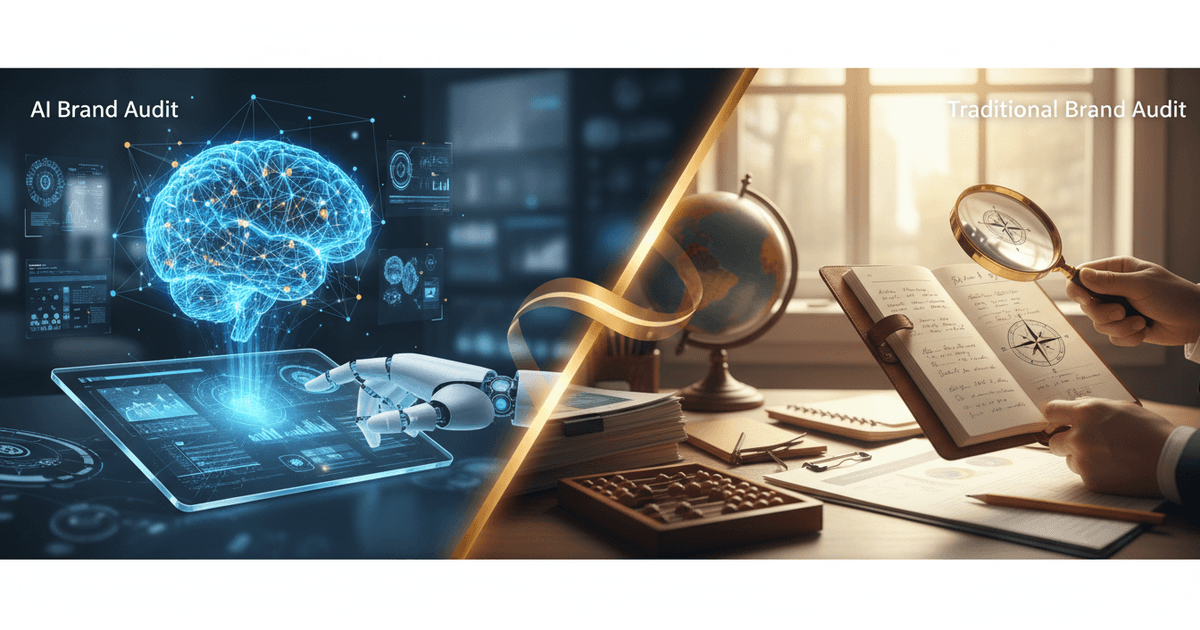
Generative AI now mediates roughly 40% of brand discovery moments for B2B buyers, according to Digiday’s 2025 reporting on AI search behavior. That single shift has made the traditional brand audit, a methodology designed around surveys, focus groups, and competitive benchmarking, structurally incomplete. Not wrong. Incomplete.
If your firm has strong delivery, a solid reputation in certain circles, and yet pipeline remains inconsistent, the instinct is to call it a marketing problem. Hire another agency, and refresh the website. Run a campaign. But the gap is almost never about marketing volume. It’s about how your firm is being interpreted, by buyers doing silent research and by the AI systems shaping what those buyers see before they ever reach your site.
The audit methodology you choose determines whether you uncover why buyers overlook you or simply confirm what leadership already suspected. Traditional audits were built for a linear research path: prospect sees an ad, visits a site, reads a case study, fills out a form. That path barely exists anymore.
This article is a head-to-head diagnostic comparison of AI brand audits and traditional brand audits, built specifically for leaders of service firms choosing between the two approaches in 2026. If you’re sensing that your authority is leaking but can’t pinpoint where, the audit type you select is the first decision that matters.
What Does a Traditional Brand Audit Actually Measure?
A traditional brand audit is a human-led, periodic review of messaging consistency, positioning, visual identity, and how clients actually perceive you. For most professional services firms, you’re looking at 6 to 12 weeks and somewhere between $15K and $75K, sometimes more.
The methodology runs on direct inputs: stakeholder interviews, client surveys, competitive benchmarking, and visual identity reviews. A brand manager or outside consultancy pulls together qualitative and quantitative data, synthesizes it into perception reports, and hands over recommendations. Here’s the thing though. PA Consulting’s research on traditional brand trackers found that these batch-based approaches collect data at fixed intervals, which creates a “rearview mirror” effect. The findings reflect sentiment from weeks or months ago, not what buyers are actually thinking right now. You’re making decisions based on old gut feelings dressed up as data.
What you’ll usually get from a traditional audit includes:
- Brand perception reports pulled from client and prospective customer surveys
- Competitive positioning maps that compare your messaging and market presence against the noise around you
- Messaging gap analysis that pinpoints where inconsistencies are quietly eroding trust across channels
- Visual identity scorecards evaluating logo usage, color compliance, and overall design coherence
These outputs genuinely matter. Internal alignment, qualitative client sentiment, competitive positioning snapshots. You can’t replicate that stuff through automation alone. When a managing partner needs to know whether the internal team describes the value proposition the same way twice, or whether clients actually perceive the firm the way leadership thinks they do, a traditional audit delivers.
The blind spot is structural. Traditional audits don’t measure how AI systems interpret and represent your firm. They can’t tell you whether ChatGPT recommends a competitor when a prospect types “best consulting firms for supply chain optimization in the Southeast.” They won’t surface the blind spots in AI brand perception that increasingly decide whether a buyer puts you on their shortlist. And they completely miss the real-time digital authority signals, citation patterns, entity recognition, and semantic consistency that now shape buyer confidence before anyone ever picks up the phone. That’s the moment of truth happening without you in the room.
How Does an AI Brand Audit Work Differently?
An AI brand audit looks at how generative AI platforms like ChatGPT, Perplexity, and Gemini perceive, describe, and recommend your firm when buyers search your category. It typically wraps up in one to three weeks, at a fraction of what a traditional audit would cost.

The process kicks off with structured querying. Rather than interviewing stakeholders, an AI brand audit systematically prompts multiple AI platforms with the questions your prospective customers are actually typing in: “Who are the top firms for [your specialty] in [your market]?” “What’s the difference between Firm A and Firm B?” “Which [service type] provider is best for mid-market companies?” What comes back is revealing. The outputs show whether AI systems even recognize your firm as an entity, how accurately they describe what you do, and whether they recommend you or quietly route buyers somewhere else. That last part is the moment of truth most firms never think to check.
David Cosgrove published one of the most thorough AI brand audit frameworks out there, a five-layer model covering knowledge accuracy, semantic consistency, and hallucination rate. He calls entity recognition the foundational metric. And that makes sense. If an AI model doesn’t recognize your firm as a distinct entity with clear attributes, nothing else in the audit matters. Game over. Your firm simply doesn’t exist in AI-driven brand discovery.
The more revealing finding isn’t absence. It’s distortion. A 50-person engineering consultancy might discover that Perplexity describes them as a “staffing agency” because their LinkedIn content leans heavily toward recruitment posts instead of thought leadership. That kind of misrepresentation quietly drains your pipeline, and nobody even realizes it’s happening.
The timeline shrinks fast compared to traditional methods. Most AI audits wrap up in one to three weeks because they’re built on automated querying and structured analysis, not months of survey collection and interview scheduling. Cost follows suit.
What an AI audit won’t tell you: whether your internal team actually agrees on positioning, how your longest-tenured clients feel about the relationship, or the subtleties of your offline reputation in a local market. Those qualitative dimensions still need human-led inquiry. No shortcut there. The two audit types measure fundamentally different layers of brand health, and that’s exactly why picking only one leaves a gap you can’t afford to ignore.
AI Brand Audit vs Traditional Brand Audit: The Side-by-Side Comparison
Traditional brand audits look at internal alignment and client sentiment. AI brand audits measure something different: how algorithms perceive your firm and whether you show up when generative search platforms make recommendations.
Most firms treat this like an either/or decision. That framing is the first mistake. Each methodology shines a light on a different layer of how your brand actually functions in the market. The table below breaks down ten criteria so you can see exactly where each approach delivers, and where it falls short.
| Audit Criteria | Traditional Brand Audit | AI Brand Audit |
|---|---|---|
| Methodology | Human-led interviews, surveys, competitive benchmarking | Structured AI platform querying, entity analysis, citation mapping |
| Primary Data Sources | Client feedback, stakeholder input, market research panels | ChatGPT, Perplexity, Gemini, Copilot outputs; citation indexes |
| Timeline | 6 to 12 weeks | 1 to 3 weeks |
| Typical Cost (Service Firms) | $15K to $75K+ | $2K to $15K depending on scope |
| Key Outputs | Perception reports, positioning maps, messaging gap analysis, visual identity scorecards | AI perception snapshot, recommendation rankings, entity consistency report, citation gap map |
| What It Measures Best | Internal alignment, qualitative client sentiment, visual consistency | Algorithmic perception, recommendation ranking, authority signal consistency |
| Blind Spots | AI-driven buyer discovery, real-time digital authority signals, entity recognition | Internal stakeholder alignment, deep qualitative sentiment, offline reputation nuance |
| Buyer Journey Coverage | Mid-to-late stage (evaluation, decision) | Early stage (discovery, shortlisting, silent research) |
| Recommended Frequency | Annually or during major repositioning | Quarterly, aligned with AI model retraining cycles |
| Best Use Case | Brand refresh, merger integration, leadership alignment | Diagnosing why qualified buyers aren’t finding or choosing the firm |
That buyer journey coverage row is worth a closer look. Traditional audits capture how prospects evaluate you once they’ve already found you. AI audits reveal something different: whether prospects find you at all during the discovery phase that now precedes most first conversations. For established service firms, that early-stage gap is usually the source of the “best-kept secret” problem. Strong delivery, weak discoverability. It’s the kind of thing that creates a gut feeling something’s off, even when your reputation is solid.
Running just one type of audit won’t give you the full picture. If you only do a traditional audit, you’ll miss the algorithmic layer that’s quietly shaping buyer shortlists before they ever reach out. And if you only run an AI audit, you’ll miss the internal misalignment that’s undermining every external signal your firm puts out.
Conventional wisdom says pick the audit that fits your budget. That’s the wrong filter. The real question is which stage of the buyer journey is broken. If your close rate is strong but the pipeline feels thin, the AI audit surfaces earlier-stage visibility failures that traditional methods simply can’t detect. Now flip it. If your pipeline is full but deals keep stalling, a traditional audit exposes the messaging and perception gaps causing all that friction. You can also run AI search visibility tests yourself to get a gut feeling for which layer needs attention first.
Why Traditional Audits Alone Create a Dangerous Blind Spot for Service Firms
Traditional brand audits miss how AI intermediaries filter and recommend firms to prospective customers, creating blind spots that grow wider with every quarterly model update.

Your traditional audit can come back pristine. Messaging aligned, visual identity consistent, client satisfaction scores strong. While you’re reading that report, Gemini is telling a prospect in your exact target audience that your top competitor is the better fit for their project. That’s the blind spot.
Conventional advice says run a brand audit every two to three years to stay aligned. That cadence was built for a world where brand perception shifted slowly, through word of mouth, trade publications, and search rankings you could monitor monthly. AI models retrain and update their knowledge bases on roughly quarterly cycles. A firm’s algorithmic representation can shift dramatically between traditional audit cycles, meaning the perception gap you’re trying to measure has already moved three or four times before your next scheduled review.
Traditional audits assume buyers discover firms through channels the firm controls: referrals, organic search rankings, conference appearances, advertising. That assumption is fracturing. Digiday’s research on AI search found that generative AI platforms are reshaping brand visibility by inserting an algorithmic intermediary between the buyer’s question and the firm’s website. For service businesses, this means a growing share of prospective customers never reach your site at all.
The real cost shows up in four specific ways:
- A clean traditional audit gives leadership false confidence that positioning is working, while AI systems actively route prospects elsewhere
- Competitors with weaker delivery but stronger digital authority signals (structured data, citation density, entity consistency) get recommended over you
- Pipeline problems get misdiagnosed as sales issues or market softness rather than visibility failures
- The firm invests in tactical outputs like refreshed collateral or updated messaging without addressing the algorithmic layer that now shapes first impressions
A traditional audit that doesn’t account for AI-mediated discovery is measuring a buyer journey that’s shrinking every quarter. For established service firms with strong reputations, this is precisely how you become the best-kept secret in your category: known by those who already found you, invisible to those still looking.
When Should You Use an AI Audit, a Traditional Audit, or Both?
Use an AI audit when pipeline is inconsistent despite strong referrals, a traditional audit after a rebrand, and a hybrid of both every 18 to 24 months for full coverage.
The decision isn’t philosophical. It’s diagnostic. Each audit type answers a fundamentally different question, and choosing wrong means spending weeks and budget measuring the wrong thing.
A traditional audit earns its place when internal alignment is broken. If your firm just went through a rebrand, merged with another practice, or your client perception data is stale, you need the qualitative depth that only stakeholder interviews and consumer behavior analysis can provide. A traditional audit tells you whether your brand story matches what clients actually experience. That insight can’t come from prompting an AI platform.
An AI audit is the right starting point when the symptoms look different: referrals are strong but inbound is flat, competitors with thinner track records keep winning RFPs, or your firm simply doesn’t surface when buyers ask AI systems for recommendations. These are signals that your authority isn’t translating into the digital layer where a growing share of brand discovery happens.
For most established service firms, the hybrid approach delivers the clearest picture. The sequencing matters. Start with an AI audit (one to three weeks) to map how algorithms currently interpret your firm’s positioning, expertise, and competitive standing. Then run a targeted traditional audit (four to six weeks) focused specifically on the gaps the AI audit flagged, rather than a broad, expensive sweep of everything. The result is an integrated remediation roadmap that covers both human and algorithmic buyer pathways.
Frequency that actually matches how fast perception shifts: AI audits quarterly, traditional audits annually, full hybrid deep-dive every 18 to 24 months. This cadence keeps you ahead of AI model retraining cycles without creating operational drag.
This might sound like doubling the cost. A targeted traditional audit scoped to AI-flagged gaps runs 40 to 60 percent cheaper than a full traditional engagement because you already know where to look. That’s the efficiency gain of leading with the AI layer. To understand the full picture, consider the five authority signal layers that shape how both buyers and algorithms evaluate service firms.
Find Out What Buyers and AI Actually See When They Research Your Firm
If your firm’s reputation isn’t generating consistent demand, the problem is likely how your authority is being interpreted, not how hard you’re marketing. You can explore the Chosen Brand Audit to pinpoint where signals are being misread or filtered out. Start with a Visibility Snapshot to see exactly what buyers and AI systems encounter when they research your firm.