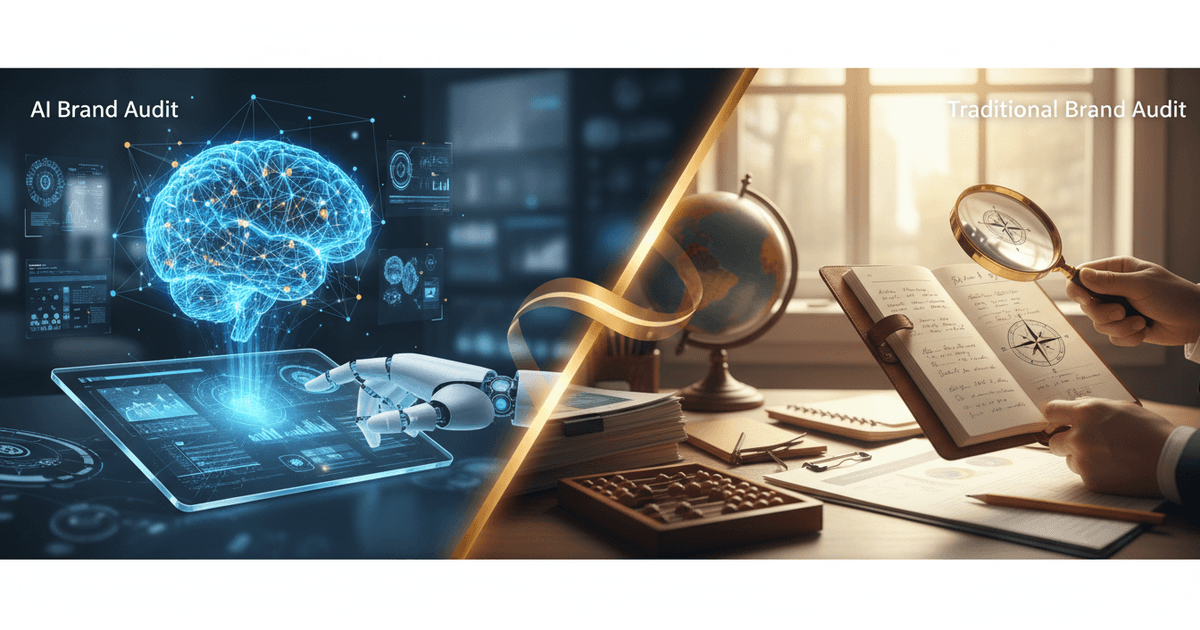
You ask ChatGPT to recommend a firm in your exact specialty, and your name doesn’t appear. Not buried at the bottom. Not misspelled. Just absent, as if twenty years of client work and referral networks never happened.
This is the reality for a growing number of established service firms. Their brand authority is real, earned, and well-known among existing clients, yet completely invisible to the AI tools that prospective customers increasingly rely on for recommendations. The disconnect isn’t a technical SEO failure. It’s a documentation gap: the signals that prove your expertise to human buyers (handshakes, keynotes, repeat engagements) simply don’t exist in the formats that ChatGPT, Perplexity, and Google AI Overviews can read.
AI search engines don’t just index your website. They evaluate a web of authority signals, from entity consistency and structured data to third-party citations and content freshness, before deciding which firms to cite. Miss enough of those signals, and your brand drops out of the conversation entirely.
The eight reasons below work as a self-diagnostic checklist. Each one identifies a specific gap and pairs it with a concrete fix, so you can pinpoint exactly where your authority signals break down and start closing the gap between your real reputation and your AI-visible one.
1. How Does AI Distinguish Between Brand Mentions and Brand Citations?
AI models treat brand mentions as passive name recognition and brand citations as active endorsements, with citation-carrying brands 40% more likely to resurface across consecutive AI queries than mention-only brands.
Raw mention volume is a vanity metric for AI visibility. AI models don’t count how often your name appears, and they evaluate how it appears. An industry publication quoting your managing partner on market trends is a citation. Your firm’s name in a directory listing is a mention. AI treats these two signals with dramatically different weight.
Research from the 2026 State of AI Search report found that roughly 85% of brand mentions in AI search come from external domains, not owned properties. Yet only 28% of AI answers include brands that carry both a mention and a citation signal. Brands that earn both are 40% more likely to resurface across back-to-back AI queries.
That dual-signal advantage matters because AI visibility is inconsistent by nature. Only about 30% of brands stay visible across consecutive AI answers, which makes single snapshots unreliable, and consistent citation-quality references are what keep you in the conversation.
A brand authority audit can reveal the gap quickly. Most service firms discover they have dozens of mentions and almost zero citations. The fix starts with classifying every existing brand reference, then converting the strongest mentions into citation-grade content.
| Signal Type | What It Looks Like | How AI Treats It | Authority Value |
|---|---|---|---|
| Brand Mention | Name appears in a directory listing or comment thread | Registers existence but not expertise | Low |
| Unlinked Reference | Blog post names your firm without linking to your site | Partial recognition; no entity verification path | Low to moderate |
| Contextual Citation | Industry article quotes your expert on a specific topic | Validates expertise within a subject area | High |
| Authoritative Citation | Research report or trade publication references your methodology or data | Treats your brand as a primary source worth recommending | Very high |
Mentions say you exist. Citations say you’re credible. AI cares far more about the second signal, and most service firms are overloaded with the first while starving for the second.
2. Your Offline Reputation Has No Digital Documentation
Service firms with strong referral networks and word-of-mouth reputations are disproportionately penalized by AI citation algorithms when that authority exists only offline.

Your best clients came through a warm introduction at an industry conference. Your firm’s reputation in a particular vertical is so established that competitors acknowledge it privately. None of that registers with AI.
Perplexity and Google AI Overviews can’t crawl a handshake. They can’t index the gut feeling a prospect gets when three colleagues independently recommend the same firm. AI models build their picture of your brand from structured, crawlable digital signals, and if your authority lives primarily in conversations, referral networks, and conference hallways, you’re invisible to every buyer who starts their search in an AI tool.
This plays out constantly in practice. A 40-person environmental consulting firm with fifteen years of project history, recognized by state agencies and repeat government clients, can be completely absent from ChatGPT’s recommendations for “top environmental consultants” in their region. Deep expertise, a dated website, and a sparse LinkedIn company page give AI nothing to work with.
The fix requires systematically translating offline authority into crawlable documentation. Speaking engagements need to appear on conference archive pages and industry publication recaps. Client success stories need to live as published case studies on authoritative third-party platforms, not just your own blog. Professional credentials and awards need entries in directories and association databases that AI actively indexes. Each of these creates a citation-quality signal where previously there was silence.
3. Why Are Your E-E-A-T Signals Failing to Register With AI?
E-E-A-T signals, specifically named author credentials and verifiable entity profiles, function as the primary trust logic AI uses to select which brands to cite.
AI doesn’t just evaluate what your content says, and it tries to verify who said it. For most service firms, that verification fails because the “who” is completely undocumented.
The pattern is remarkably consistent: high-quality articles published under “Our Team” or a company byline with zero author attribution. No bio. No entity profile connecting the author to a professional history AI can verify. No linked credentials. The content itself might be excellent, but AI can’t distinguish it from generic copy generated by anyone.
According to a March 2026 AI Brand Visibility Report, YouTube mentions and branded web mentions rank among the top factors correlating with AI brand visibility across ChatGPT, AI Mode, and AI Overviews. Video content featuring named experts with visible credentials carries disproportionate weight, yet most service firms ignore this signal entirely.
The fix is granular but straightforward. Every piece of published content needs a named author with a bio that includes verifiable credentials. Those authors need active LinkedIn profiles and, ideally, professional profiles on industry-specific platforms, and author schema markup should connect each content piece to its creator’s entity profile. If your firm’s leadership has genuine expertise (they almost certainly do), getting them on camera with their credentials displayed creates exactly the kind of E-E-A-T signal AI rewards.
4. Your Content Answers Questions AI Never Gets Asked
AI search engines prioritize content that directly answers conversational buyer queries, yet most service firm content is built around brand positioning rather than question-based formats.

Most firm websites read like brochures: “Our approach,” “Why choose us,” “Our values.” That content serves a purpose for someone already on your site, but AI tools never surface it because nobody asks ChatGPT, “What are the values of [firm name]?” They ask, “What’s the best approach to commercial lease negotiation for multi-tenant properties?” or “How do I choose a cybersecurity auditor for healthcare compliance?”
The mismatch is structural. Analysis of over 2,500 domains cited by AI search engines found that listicle-format content (structured comparisons and rankings) accounted for 59.5% of cited URLs. Product pages?, and just 8.5%. Standard articles? 7.9%. If your content library is dominated by service descriptions and thought leadership essays, you’re publishing in formats AI rarely cites.
Content freshness compounds the problem. Newly published content can begin generating AI citations within three to five days, but citation performance typically starts declining after four to five days without updates. That decay pattern holds across ChatGPT, Google AI Overviews, and Perplexity. The most visible brands in competitive categories publish two or more structured pieces per week.
Start by researching the actual questions buyers type into AI tools. People Also Ask data, Perplexity’s suggested queries, and running your own test prompts in ChatGPT will reveal the conversational queries your content should target. Then answer each one directly within the first 50 words of the piece. A visibility snapshot can expose the gap between what you’re publishing and what AI actually surfaces.
5. How Does Missing Structured Data Make Your Brand Invisible to AI?
Without Organization, Person, Service, and FAQ schema markup, AI models are left guessing your brand’s identity from unstructured text. They’ll misread you, or worse, skip right past you entirely.
Schema markup is your brand’s declaration to AI: this is who we are, this is what we do, and these are the people behind our expertise. Without it, you’re asking AI to piece together your identity from scattered, unstructured signals across the web. For firms with straightforward names and single locations, AI might get close enough. But for anyone operating under multiple service lines, DBAs, or regional offices? The result is entity confusion. And confused AI doesn’t cite. It skips.
Entity identity consistency across the web is a foundational signal for AI citation decisions. When AI crawls your site and finds no Organization schema, no Person schema for your leadership team, and no Service schema defining your offerings, it’s forced to guess. Guessing leads to errors. Those errors mean your firm gets conflated with similarly named entities, or worse, gets left out of responses where you’re genuinely the best answer. That’s game over for your mindshare before a prospective customer even knows you exist.
Digging into how AI sees your brand usually turns up entity mismatches you didn’t expect, and structured data is what fixes them.
For service firms, the implementation priority is pretty specific. Organization schema establishes your company entity. Person schema documents your key experts and their credentials, tying directly back to those E-E-A-T signals covered above. Service schema spells out your offerings so AI doesn’t have to dig through marketing copy to figure out what you actually do. FAQ schema answers common buyer questions in a format AI can extract and cite word for word. Each layer cuts down the guesswork AI has to perform. And every reduction in that guesswork improves your odds of being cited over a competitor whose identity AI can’t verify with the same confidence.
6. You Lack Third-Party Validation AI Models Trust
AI models weigh third-party mentions in industry publications, directories, and review platforms as citation-grade evidence. Self-published content on its own? It rarely moves the needle when those models decide which brands to recommend.

AI doesn’t trust self-attestation. It cross-references. When Sight AI analyzed which brands consistently earned AI citations, the pattern was clear: firms mentioned across multiple independent, authoritative sources got recommended. Firms relying only on self-published content? They got skipped entirely.
Going after mainstream press is the standard advice. But here’s the thing: for a $12M environmental consulting firm or a niche IT compliance practice, a mention in a trade journal like Environmental Science & Technology or ISACA’s publications carries way more citation weight than a generic Inc. article. AI models match source authority to topic relevance. That means industry-specific validation outperforms broad-market PR almost every time, and it’s not even close.
Building this validation the right way means going after the external signals that actually matter:
- Directory listings on platforms AI actively crawls (Clutch, industry-specific associations, state licensing boards)
- Guest contributions in trade publications your target audience already reads
- Client reviews on Google Business Profile, LinkedIn recommendations, and vertical review sites
- Speaking engagements and panel discussions that get documented on third-party event pages
Here’s something most people overlook: a single detailed client review on a reputable platform can generate more AI citations than ten self-published testimonials sitting on your own site. That’s the game. Start there. If you want a deeper look at how advisory firms build brand authority through documented client outcomes, that resource breaks down exactly how the mechanics work.
7. What Happens When Your Entity Identity Is Fragmented Across the Web?
When your business name, descriptions, and leadership details don’t match across platforms, AI can’t build a unified entity graph. The result? It simply leaves your brand out of generated answers. Game over.
A regional accounting firm with 40 employees recently found they showed up under three different names online: their legal entity name on state licensing sites, a shortened version on LinkedIn, and a legacy DBA on their old Google Business Profile. AI couldn’t reconcile these as one firm. The result? Zero citations across any AI platform. That’s despite strong client satisfaction and a solid 15-year track record.
This fragmentation is the silent killer of AI visibility. It sneaks up on you. A rebrand that nobody bothered updating on Yelp. A leadership change that left the old managing partner’s name sitting on industry directory profiles. Service descriptions that say “tax advisory” on your website but “accounting services” in your Chamber of Commerce listing. Every single inconsistency chips away at the confidence score AI assigns to your entity.
The bigger issue isn’t one specific mismatch. It’s the cumulative effect that kills you. AI models evaluate brand authority audit signals across dozens of sources at the same time, and conflicting data points compound fast. Three minor inconsistencies can actually hurt more than one major error, because they signal something worse: the entity itself looks unreliable. That’s when perception is reality kicks in, and it’s basically game over for your recommendation score.
The fix here is a full entity consistency audit:
- Map every platform where your firm shows up (directories, social profiles, review sites, association memberships, event pages)
- Standardize your business name, description, service categories, and key personnel across all of them. Inconsistency here is game over for mindshare.
- Consolidate or redirect legacy listings from old brand names or DBAs. These ghost profiles confuse both buyers and AI.
- Build a canonical entity profile on your website using structured data, so it serves as the single source of truth for who you are and what you do
8. You Haven’t Audited How AI Actually Sees Your Brand Today
Most service firms have never queried their own brand in AI search tools, leaving them unaware of how AI describes, misrepresents, or completely ignores their expertise.

Ranking on page one of Google for your target keywords tells you almost nothing about how AI treats your brand. Traditional search rewards page-level optimization. AI search evaluates your entire brand entity across multiple platforms, each with its own citation logic. A firm can dominate Google organic results and still be completely absent from AI-generated recommendations.
The self-audit process is straightforward but revealing. Search your brand name, your core services, and the buying questions your prospective customers actually ask across multiple AI platforms. Then compare the outputs against your real positioning. The gaps are often startling: AI might describe a cybersecurity firm as a “general IT services provider” or omit a firm’s primary specialty entirely. Understanding how AI search is rewriting brand discovery gives you context for why these mismatches happen.
Run these queries monthly, not once. AI models update their training data and source weighting regularly, so a brand that appears in AI results today can vanish next month if competitors strengthen their entity signals faster.
Document everything: whether your brand appears at all, how it’s described, which sources AI cites, and whether you show up as a recommendation or just a passing mention. That baseline becomes your roadmap. Without it, every fix you attempt is a gut feeling, not a strategy.
Frequently Asked Questions About Brand Authority in AI Search
Why does my brand rank on Google but not show up in AI search results?
Google rankings depend on backlinks, keyword optimization, and page authority. AI search engines work differently. They evaluate your brand as an entity, pulling signals from third-party sources, structured data, and cross-platform consistency. That page-one Google position won’t automatically translate into an AI citation. The evaluation logic is fundamentally different, and that’s the part most businesses completely miss.
How do AI search engines decide which brands to cite?
They build entity graphs from every source they can get their hands on. From there, they’re weighing third-party validation, how relevant your content is to the specific query, structured data markup, and whether your brand information stays consistent across platforms. Brands that show up with verifiable expertise across multiple authoritative, independent sources? They earn citations. The ones relying solely on their own website typically don’t.
Can I check if my brand appears in AI search results?
Yes. Query your brand name, your services, and common buyer questions across major AI platforms. Then compare what comes back against your actual positioning and specialties. The whole thing takes about 30 minutes. You’ll quickly see whether AI is citing you, misrepresenting you, or flat-out ignoring you.
How long does it take to fix AI search invisibility for a service firm?
Structured data fixes and entity consistency corrections can show up in results within 30 to 60 days. That’s your quick win. Building citation-grade authority through third-party validation and sustained content publishing? That’s a longer game. You’re typically looking at 60 to 90 days before measurable changes start showing up in AI outputs.
Is AI search visibility different from traditional SEO for professional services?
Totally. Traditional SEO is about optimizing individual pages for keyword rankings. AI visibility? Different game entirely. It’s about optimizing your whole brand entity: how consistently you’re described across the web, whether independent sources back up your expertise, and whether your structured data gives AI enough confidence to actually cite you in generated responses.
Find Out Exactly How AI Sees Your Brand Right Now
Every fix in this article starts with the same prerequisite: knowing exactly what AI currently says (or doesn’t say) about your firm. The Visibility Snapshot shows you how buyers and AI interpret your brand authority right now, so you can stop guessing and start closing the gaps that keep you invisible.