
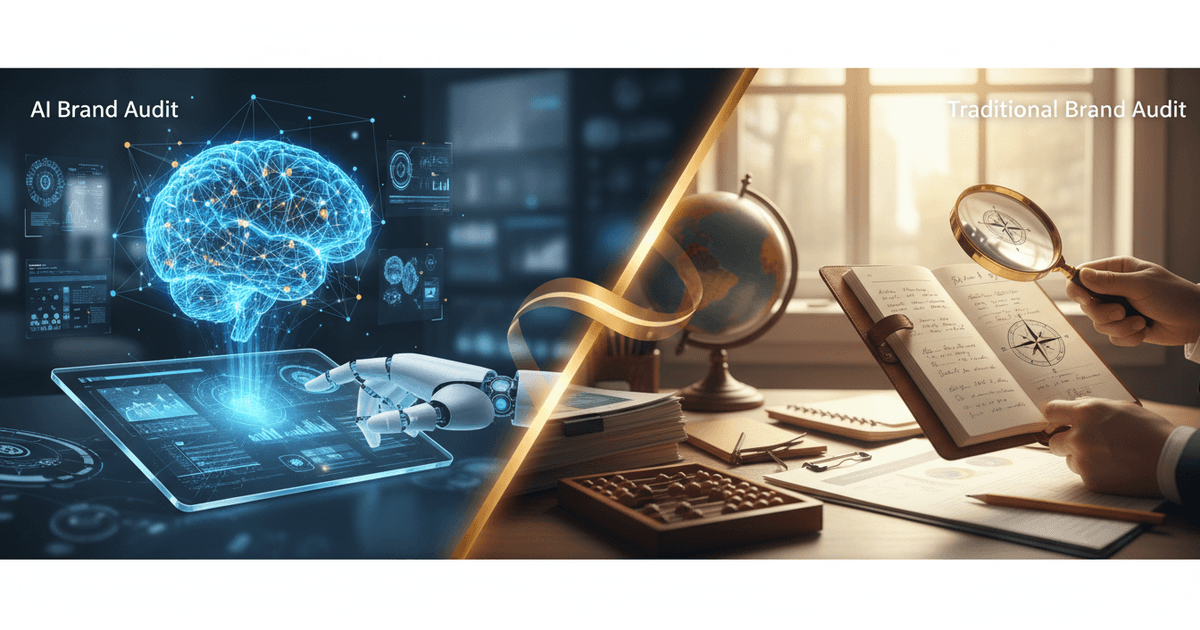
Generative AI now mediates roughly 40% of brand discovery moments for B2B buyers, according to Digiday’s 2025 reporting on AI search behavior. That single shift has made the traditional brand audit, a methodology designed around surveys, focus groups, and competitive benchmarking, structurally incomplete. Not wrong. Incomplete.
If your firm has strong delivery, a solid reputation in certain circles, and yet pipeline remains inconsistent, the instinct is to call it a marketing problem. Hire another agency, and refresh the website. Run a campaign. But the gap is almost never about marketing volume. It’s about how your firm is being interpreted, by buyers doing silent research and by the AI systems shaping what those buyers see before they ever reach your site.
The audit methodology you choose determines whether you uncover why buyers overlook you or simply confirm what leadership already suspected. Traditional audits were built for a linear research path: prospect sees an ad, visits a site, reads a case study, fills out a form. That path barely exists anymore.
This article is a head-to-head diagnostic comparison of AI brand audits and traditional brand audits, built specifically for leaders of service firms choosing between the two approaches in 2026. If you’re sensing that your authority is leaking but can’t pinpoint where, the audit type you select is the first decision that matters.
What Does a Traditional Brand Audit Actually Measure?
A traditional brand audit is a human-led, periodic review of messaging consistency, positioning, visual identity, and how clients actually perceive you. For most professional services firms, you’re looking at 6 to 12 weeks and somewhere between $15K and $75K, sometimes more.
The methodology runs on direct inputs: stakeholder interviews, client surveys, competitive benchmarking, and visual identity reviews. A brand manager or outside consultancy pulls together qualitative and quantitative data, synthesizes it into perception reports, and hands over recommendations. Here’s the thing though. PA Consulting’s research on traditional brand trackers found that these batch-based approaches collect data at fixed intervals, which creates a “rearview mirror” effect. The findings reflect sentiment from weeks or months ago, not what buyers are actually thinking right now. You’re making decisions based on old gut feelings dressed up as data.
What you’ll usually get from a traditional audit includes:
- Brand perception reports pulled from client and prospective customer surveys
- Competitive positioning maps that compare your messaging and market presence against the noise around you
- Messaging gap analysis that pinpoints where inconsistencies are quietly eroding trust across channels
- Visual identity scorecards evaluating logo usage, color compliance, and overall design coherence
These outputs genuinely matter. Internal alignment, qualitative client sentiment, competitive positioning snapshots. You can’t replicate that stuff through automation alone. When a managing partner needs to know whether the internal team describes the value proposition the same way twice, or whether clients actually perceive the firm the way leadership thinks they do, a traditional audit delivers.
The blind spot is structural. Traditional audits don’t measure how AI systems interpret and represent your firm. They can’t tell you whether ChatGPT recommends a competitor when a prospect types “best consulting firms for supply chain optimization in the Southeast.” They won’t surface the blind spots in AI brand perception that increasingly decide whether a buyer puts you on their shortlist. And they completely miss the real-time digital authority signals, citation patterns, entity recognition, and semantic consistency that now shape buyer confidence before anyone ever picks up the phone. That’s the moment of truth happening without you in the room.
How Does an AI Brand Audit Work Differently?
An AI brand audit looks at how generative AI platforms like ChatGPT, Perplexity, and Gemini perceive, describe, and recommend your firm when buyers search your category. It typically wraps up in one to three weeks, at a fraction of what a traditional audit would cost.

The process kicks off with structured querying. Rather than interviewing stakeholders, an AI brand audit systematically prompts multiple AI platforms with the questions your prospective customers are actually typing in: “Who are the top firms for [your specialty] in [your market]?” “What’s the difference between Firm A and Firm B?” “Which [service type] provider is best for mid-market companies?” What comes back is revealing. The outputs show whether AI systems even recognize your firm as an entity, how accurately they describe what you do, and whether they recommend you or quietly route buyers somewhere else. That last part is the moment of truth most firms never think to check.
David Cosgrove published one of the most thorough AI brand audit frameworks out there, a five-layer model covering knowledge accuracy, semantic consistency, and hallucination rate. He calls entity recognition the foundational metric. And that makes sense. If an AI model doesn’t recognize your firm as a distinct entity with clear attributes, nothing else in the audit matters. Game over. Your firm simply doesn’t exist in AI-driven brand discovery.
The more revealing finding isn’t absence. It’s distortion. A 50-person engineering consultancy might discover that Perplexity describes them as a “staffing agency” because their LinkedIn content leans heavily toward recruitment posts instead of thought leadership. That kind of misrepresentation quietly drains your pipeline, and nobody even realizes it’s happening.
The timeline shrinks fast compared to traditional methods. Most AI audits wrap up in one to three weeks because they’re built on automated querying and structured analysis, not months of survey collection and interview scheduling. Cost follows suit.
What an AI audit won’t tell you: whether your inte