Before the authority diagnostic, a firm gets passed over by three qualified prospects in a quarter. After, buyers start citing the firm’s expertise during discovery calls, unprompted. The gap between those two realities has almost nothing to do with reputation.
You’ve built something that delivers. Referrals come in. Clients stay. But somehow, a competitor with half your track record keeps showing up on shortlists you never even make. The instinct is to assume people must be saying something negative, so you start monitoring reviews, scanning Google results, and thinking about brand reputation management. That instinct is wrong about 80% of the time for established service firms.
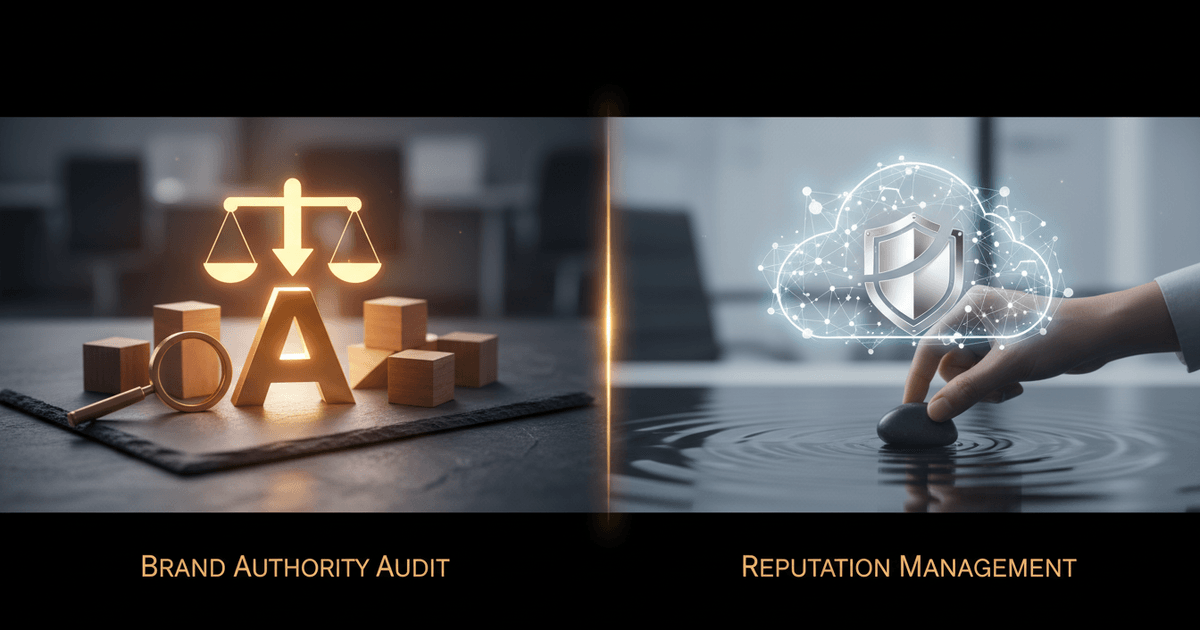
Reputation management protects what people already think about you. A brand authority audit diagnoses something earlier and more expensive: why the right buyers never encounter you in the first place. One manages a conversation that’s already happening. The other asks why you aren’t part of the conversation at all.
This piece is a decision-making guide. By the end, you’ll know which problem you’re actually solving, which tool fits, and where most firms burn budget fixing the wrong thing.
What Is a Brand Authority Audit and What Does It Actually Measure?
A brand authority audit evaluates how buyers and AI systems interpret your firm’s expertise, positioning, and trust signals before any engagement occurs, measuring selection likelihood rather than sentiment.
Think about the last time you lost a deal to a competitor you know you’d outperform. The prospect didn’t have a bad impression of your firm. They never formed an impression at all. That’s the gap a brand authority audit is designed to find.
A brand authority diagnostic differs from a reputation audit in one critical way: reputation audits measure how people feel about you, while authority audits measure whether you’re even in the consideration set. Moz’s Brand Authority score, measured on a 1 to 100 scale, quantifies influence through traffic, engagement, and backlinks. For service businesses, though, the real diagnostic goes deeper than any single metric.
A thorough authority audit typically evaluates:
- Entity identity consistency across platforms, directories, and AI knowledge bases
- AI recommendation signals that determine whether tools like ChatGPT, Perplexity, or Google AI Overviews surface or suppress your firm
- Positioning clarity, specifically whether your expertise reads as distinct or generic to a prospective customer researching options
- Proof architecture, including the depth and credibility of case studies, credentials, and third-party validation
- Competitive differentiation signals that separate you from firms making identical claims
- Buyer research path alignment, mapping whether your digital presence matches how your target audience actually evaluates and selects providers
This is the dimension most firms miss entirely. AI recommendation engines don’t just index your website; they interpret your authority signals to decide whether you get recommended. A firm with strong delivery but weak entity consistency, thin content architecture, or scattered positioning gets suppressed in AI search results. That suppression happens silently. No notification. No negative review. Just absence.
The orientation here’s forward-looking. You’re not cleaning up past damage. You’re diagnosing why your firm, despite being genuinely excellent, operates as the industry’s best-kept secret.
What Is Reputation Management and Where Does It Apply?
Reputation management is a reactive discipline focused on monitoring, responding to, and mitigating negative sentiment across reviews, press, search results, and social media channels.

ORM earns its keep in specific, high-stakes situations. According to SOCi data, 87% of consumers read reviews before making a purchase, and 81% avoid businesses rated below three stars. If your firm faces a review crisis or a damaging search result on page one, reputation management tools are the right response.
The common advice is that every business needs ongoing reputation management. Most established service firms with strong delivery, though, don’t have a sentiment problem. They have a visibility and authority signal problem. ORM assumes people are already talking about you and that the conversation needs steering. For a B2B specialty practice or professional services firm where deals close through research and validation, the conversation often hasn’t started because buyers never found you during their research path.
ORM typically covers review monitoring and response, negative search result suppression, crisis communication planning, sentiment analysis across social and media channels, and social listening for brand mentions. These are real capabilities, and they matter in industries with high public visibility. RepTrak, for example, has built an entire platform around measuring corporate reputation scores for large consumer-facing brands.
Here’s where the limitation becomes costly for service business owners: 53% of consumers expect brands to respond to reviews, yet 63% report never receiving a response. That gap represents a genuine ORM opportunity. Still, responding to reviews doesn’t create the conditions for being chosen. It manages perception after someone already knows you exist. For a firm whose pipeline depends on being discovered, validated, and recommended during a buyer’s research process, ORM addresses a downstream symptom while the upstream cause, insufficient authority signal, goes undiagnosed.
Sentiment isn’t selection. Managing what people say about you is a different discipline than ensuring the right people find you at the moment of truth.
How Do Brand Authority Audits and Reputation Management Compare Side by Side?
Authority audits are proactive diagnostics measuring selection likelihood; reputation management is reactive, protecting existing perception. They solve different problems with different tools.
The fastest way to waste budget on either discipline is to treat them as interchangeable. They aren’t. One answers “why don’t qualified buyers choose us?” The other answers “how do we protect what people already think?” Confusing the two leads to months of effort aimed at the wrong problem.
This comparison across eight dimensions makes the distinction concrete:
| Dimension | Brand Authority Audit | Reputation Management (ORM) |
|---|---|---|
| Core Function | Diagnoses why a firm isn’t found or selected | Monitors and mitigates negative perception |
| Strategic Orientation | Proactive, forward-looking | Reactive, protective |
| Primary Question Answered | “Why aren’t qualified buyers choosing us?” | “What are people saying about us?” |
| What It Measures | Entity consistency, positioning clarity, proof depth, AI signals | Review sentiment, media mentions, search result tone |
| AI Search Readiness | Evaluates whether AI tools recommend the firm | Does not measure AI recommendation signals |
| Best For | Established firms with strong delivery but inconsistent demand | Firms facing active negative sentiment or crisis |
| Typical Trigger | Competitors with weaker capability keep winning deals | Negative review spike, PR crisis, damaging search results |
| Output | Authority gap map with prioritized corrections | Sentiment report with response protocols |
The AI search readiness row deserves a hard look. Tools built for ORM, even sophisticated ones, don’t evaluate whether ChatGPT or Google AI Overviews would recommend your firm for a given query. That’s a fundamentally different measurement, closer to what an authority audit vs SEO audit comparison reveals about the gaps between traditional search optimization and authority diagnostics.
The proactive versus reactive framing actually undersells the real difference. A proactive brand authority strategy builds the conditions that make reputation management easier over time. When your positioning is clear, your proof architecture is deep, and AI systems consistently surface you as a credible option, the downstream reputation signals tend to take care of themselves. The reverse doesn’t hold. No amount of review monitoring creates authority where it doesn’t exist.
When Should a Service Firm Prioritize an Authority Audit Over Reputation Management?
Established service firms should prioritize an authority audit when referrals are strong but pipeline is inconsistent, and reputation management when negative sentiment actively suppresses demand.

The decision framework here’s sequential, not either/or. Most firms get the order wrong.
Consider a firm like BDO, the global accounting and advisory network. BDO consistently ranks among the top-tier professional services firms in delivery quality, yet in certain regional markets, smaller competitors with sharper digital positioning capture disproportionate inbound inquiry volume. The problem isn’t that prospects dislike BDO. The problem is that BDO doesn’t surface as the obvious choice during the research phase. That’s an authority architecture gap, not a reputation gap.
Prioritize an authority audit when you recognize these patterns:
- Referrals keep the lights on, but you can’t predict next quarter’s pipeline with any confidence
- AI search tools surface competitors, directories, or listicles instead of your firm when prospects search your category
- You’re known in pockets (a specific geography, a single referral network) but not the default choice across your target audience
- Firms with objectively weaker delivery consistently win because their signals are louder or more coherent
- Leadership senses authority is leaking but can’t pinpoint whether it’s positioning, digital presence, or proof architecture
Prioritize reputation management when negative reviews or press are actively driving prospects away, a crisis event demands immediate response, or you’re a consumer-facing brand with high review volume that requires ongoing sentiment monitoring.
Some firms need both simultaneously, especially when scaling into new markets where authority must be established while existing reputation is protected. For most established service businesses, the authority diagnostic comes first. You can’t manage the reputation of a market position you haven’t built yet. Spending six months on ORM when the real issue is that buyers never find you is like installing a security system on a house nobody knows exists.
Why AI Search Makes the Authority Audit vs ORM Distinction Urgent
AI recommendation engines like ChatGPT, Perplexity, and Google AI Overviews evaluate entity consistency and expertise depth, not star ratings, making authority audits essential for visibility.
Buyers have quietly changed how they validate service providers. Before they ever visit your website, they’re asking AI tools questions like “best environmental consulting firm for mid-market manufacturers” or “top M&A advisory for healthcare.” ReviewTrackers data shows 64% of consumers rely on search engines during their research process, and that number accelerates as AI-powered search becomes the default entry point.
ORM tools were built for a different era. They monitor review platforms, flag negative mentions, and help you respond to sentiment shifts. Useful when the problem is what people say about you. Completely insufficient when the problem is that AI systems don’t recognize you as a credible entity in your category at all.
AI recommendation engines interpret your firm through a different lens: entity consistency across platforms, structured proof of expertise, citation patterns from authoritative sources, and depth of topical coverage. These are brand authority signals that no reputation monitoring dashboard measures. A firm could have a perfect 5.0 rating across every review site and still be invisible to AI search because its authority architecture is fragmented or shallow.
You might think AI search is still early and most of your buyers aren’t using it yet. The shift is happening faster than most firms realize, though. Google AI Overviews already appear in a significant portion of search results, and Perplexity’s user base grew rapidly through 2024 and into 2025. The firms AI recommends get the first conversation. Everyone else competes for whatever attention is left. For B2B and professional services, where a single engagement can be worth six or seven figures, being excluded from that initial AI-generated shortlist is a cost you can’t afford to ignore.
Diagnose the Real Problem Before Choosing the Tool
Authority leakage requires a diagnostic audit to identify specific signal gaps; reputation problems require monitoring tools to track and respond to sentiment.

Most established service firms don’t need louder signals. They need coherent ones. The positioning page says one thing, the LinkedIn profiles say another, and the case studies haven’t been updated since 2022. Buyers and AI systems encounter these inconsistencies and move on. That’s not a reputation problem. That’s an authority architecture problem, and no amount of review monitoring will fix it.
Diagnosis always comes first. Before committing budget to any tool or tactic, you need a clear picture of where authority is actually leaking. Is it positioning clarity? Digital proof architecture? Entity recognition across AI systems? The answer determines whether you need a proactive brand authority strategy, reputation management, or a sequenced combination. The Chosen Brand Audit was designed specifically for this moment of truth: pinpointing where the gap lives between what you’ve built and how the market interprets it, so you stop investing in the wrong fix.
Find Out Where Your Authority Is Leaking
If you’re the best-kept secret in your category and tired of watching less capable competitors get chosen first, the problem is diagnosable. Apply for the Chosen Brand Audit to get a clear picture of where authority is leaking and what to fix first.

